
ByJohn A
The Two-Hour Lie: What the Denver to Vail Drive Really Costs You
It was Presidents’ Day weekend, 2023. A family of four landed at Denver International Airport at 3:47 PM, right on schedule. They’d rented an SUV — a standard crossover with all-season tires — because the rental counter agent said it was “totally fine for the mountains.” They punched Vail into the GPS and saw the magic number: 1 hour, 58 minutes. Before booking transportation, knowing the exact distance to Vail is only part of the equation — mountain weather and traffic matter just as much. They found that out on mile marker 216 of I-70, where they sat completely still for two hours while a jackknifed semi blocked all westbound lanes near the Eisenhower Tunnel. They finally checked into Vail at 10:30 PM. The kids never made first-day ski school. The parents never fully unwound.
That story isn’t unusual. It’s practically a rite of passage on the Denver–Vail corridor. And the system that keeps producing it — built on mismatched expectations, under-regulated rental fleets, and a highway designed for a Colorado that no longer exists — is worth a hard look before you book your next ski trip.
One Road, Zero Alternatives: The I-70 Problem
Here’s the structural reality nobody prints on ski resort brochures. There is exactly one primary highway connecting Denver to Vail. One. The same 119 miles of asphalt that served Colorado’s mountain towns in the 1970s now carries roughly 35,000 vehicles per day during ski season, according to the Colorado Department of Transportation. That number spikes dramatically on winter weekends.
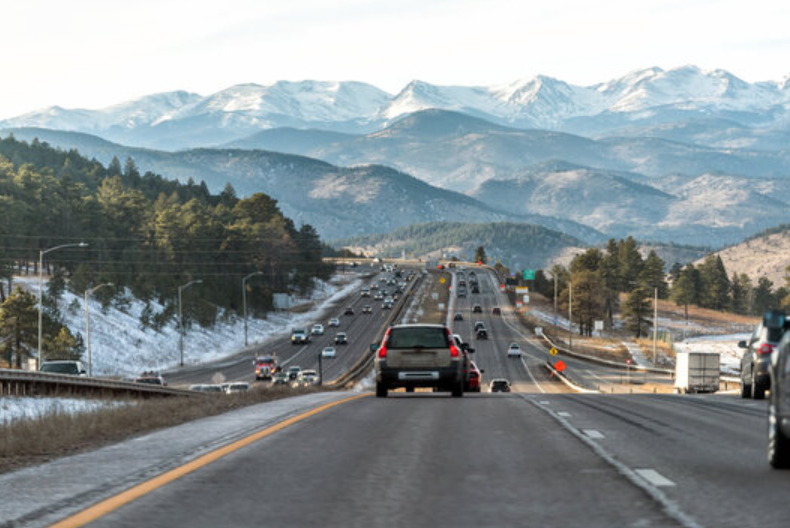
The road itself is genuinely hostile. I-70 climbs from Denver’s 5,280 feet to the Eisenhower-Johnson Memorial Tunnel at 11,158 feet — the highest point on the entire U.S. Interstate Highway System. Then it drops into Summit County, climbs again over Vail Pass at 10,662 feet, and finally descends into Vail Village. You gain and lose a vertical mile of elevation, twice, in under two hours. Under ideal conditions.
Conditions are rarely ideal between November and April.
CDOT data shows that I-70 between Denver and Vail sees significant weekend backups almost every Friday evening from October through March. The westbound delay pattern is predictable to the hour: congestion builds near Floyd Hill starting around 3 PM, tightens through the C-470 interchange, and typically doesn’t clear until well after 8 PM. That 2-hour drive the GPS promised? On a ski Friday it’s a 4-hour reality for anyone who didn’t leave by noon.
Sunday is worse in reverse. Eastbound traffic from Vail and Summit County stacks up through the Eisenhower Tunnel approach and backs up for miles. Leave after 11 AM on a Sunday in January and you’re looking at a significantly longer return trip than you planned. CDOT’s own COtrip.org system documents these patterns in real time, but most visitors don’t know to check it.
See also: Tool-Like Thermal Camera for Building Inspection: Key Features and Applications
The Traction Law Nobody Told You About
Here’s where the story gets genuinely alarming, and where institutional responsibility starts to blur.
Colorado’s Traction Law — which CDOT activates on I-70’s mountain corridor — requires all vehicles to have either all-wheel or four-wheel drive with adequate tread, dedicated snow tires, or tire chains. It runs from September 1 through May 31. It applies to rental cars. And it carries real fines for non-compliant vehicles caught on the highway during an activation.
Now ask yourself: how many rental car counters at Denver International Airport proactively tell customers whether their assigned vehicle meets Traction Law requirements? The answer, based on consistent traveler reports, is: almost none. Standard “all-season” tires — the default on most rental fleet vehicles — are not the same as winter-rated tires. They perform meaningfully worse on packed snow and ice at elevation. The Federal Highway Administration has published research confirming that proper winter tires reduce braking distances on snow and ice by up to 25% compared to all-season alternatives.
This matters because a non-compliant vehicle doesn’t just put your family at risk. It can trigger cascading delays for everyone behind a fender-bender or spin-out. CDOT data shows that weather-related crashes are among the top three causes of I-70 closures each season. Every stuck or wrecked vehicle with inadequate tires isn’t just a personal problem. It’s a public one.
And yet the rental industry isn’t required to disclose tire ratings at point of sale. CDOT can’t police every rental transaction. The Colorado Tourism Office promotes Vail aggressively without mandatory driving preparedness messaging. The gap in accountability is wide open — and visitors walk into it every single weekend.
The Shuttle Trap: Cheap Seats, Expensive Surprises
So maybe you’re smarter than the rental car gamble. You book a shared shuttle. It seems economical on paper — a per-seat fare that looks low until you add the full picture.
Shared shuttles run on fixed schedules. They make multiple stops. A 2-hour drive becomes a 3.5-hour transfer when you’re the last dropoff and the shuttle waited 40 minutes in Frisco for a delayed passenger. Your flight lands late? The shuttle doesn’t wait. You’re rebooking or scrambling for alternatives at 9 PM in an unfamiliar airport.
For a solo traveler on a budget, a shared shuttle can make sense. But run the math for a family of four with two ski bags and a car seat. Per-seat pricing multiplies fast. Baggage fees stack on top. And the schedule inflexibility means you’re building your arrival plans around the shuttle’s timetable, not your actual flight.
There’s also no flight tracking built into most shared shuttle models. Your pilot announces a 45-minute delay. The shuttle’s departure time doesn’t move. You either scramble to reach someone by phone or you’re on your own.
What Actually Works on This Corridor
The transportation options that work best on the Denver–Vail run share a few qualities: dedicated vehicles, local driver knowledge, and the ability to adapt in real time when I-70 does what I-70 does.
A private car service with mountain-specific operations solves the problems that rental cars and shared shuttles can’t. The vehicle is reserved for your group only — no extra stops, no shared timeline, no waiting for strangers at a pick-up point. The driver knows the road because they drive it every single day, not occasionally. When Vail Pass closes and CDOT reroutes traffic through Leadville or via US-285, an experienced local driver is already moving, not sitting on hold with an 800 number.
Blue Sky Limo has been operating this specific corridor since 2012. Every vehicle in their fleet is AWD and equipped with studded snow tires in winter — that’s not just meeting Colorado’s Traction Law, it’s exceeding it. They run flight tracking, so if your arrival pushes back by an hour, your pickup adjusts automatically. No frantic texts, no missed connections, no one standing at baggage claim wondering where their driver is.
The pricing model matters too. Blue Sky charges a flat per-vehicle rate, not per seat. For a family of four or a group of friends, the per-person cost often lands close to — or below — what a shared shuttle charges once luggage and flexibility costs are factored in. A Large SUV from DEN to Vail in winter season runs around $645. Split four ways, that’s roughly what you’d pay per person for a shared shuttle that stops in three towns before yours.
They’re rated #1 of 36 transportation services in Vail on TripAdvisor — not self-reported, not cherry-picked testimonials, but a ranking earned across thousands of independent reviews over more than a decade of operation.
The Hidden Cost of “Figuring It Out”
Every year, millions of dollars in ski vacation value evaporates on I-70. Missed first tracks. Late hotel check-ins. Kids who’ve been awake since 4 AM still sitting in a rental car at 11 PM. Anxiety about whether all-season tires are going to hold on a 7% grade in a February snowstorm. None of that appears in the vacation brochure.
The systemic failure here is that the default options — rental car, shared shuttle, “we’ll figure it out” — are presented as adequate without honest disclosure of the conditions that make them inadequate. CDOT publishes the data. The Traction Law exists in statute. The Friday afternoon traffic patterns are documented and predictable. But that information doesn’t reach most visitors before they’re already at the rental counter clicking “confirm.”
Planning a Vail trip means building in honest time buffers for ski season driving. It means checking COtrip.org before you leave the airport. It means understanding that the GPS estimate assumes dry pavement and no incidents at the tunnel. And it means evaluating transportation options based on what the drive actually is, not what it looks like on a map.
Before You Book: A Fast Framework
- If you’re traveling solo and budget is the priority: a shared shuttle works, but confirm their flight-delay policy before you book.
- If you’re traveling with a group of three or more: run the per-person math against a flat-rate private transfer. You may be surprised.
- If you’re arriving on a Friday or leaving on a Sunday: add at least 90 minutes to any estimated drive time during ski season. Budget more for storm windows.
- If you’re renting a car: ask specifically whether your assigned vehicle has winter-rated tires. “All-season” is not a yes. Verify before you leave the lot.
- If you want none of the above to be your problem: book a private transfer with a local operator who drives I-70 daily, carries proper winter tires, and tracks your flight. That’s not a luxury upsell. For a mountain drive like this one, it’s a logistics decision.
The Denver–Vail corridor is one of the great drives in America. On a clear October morning with the aspens turning gold, it earns every piece of that reputation. In a February snowstorm on a Friday night in a rental crossover with all-season tires, it’s something else entirely. The distance to Vail hasn’t changed. The mountains have always been the variable. Plan around what the drive actually is, not what the GPS says at sea level, and your vacation starts the moment you land.
