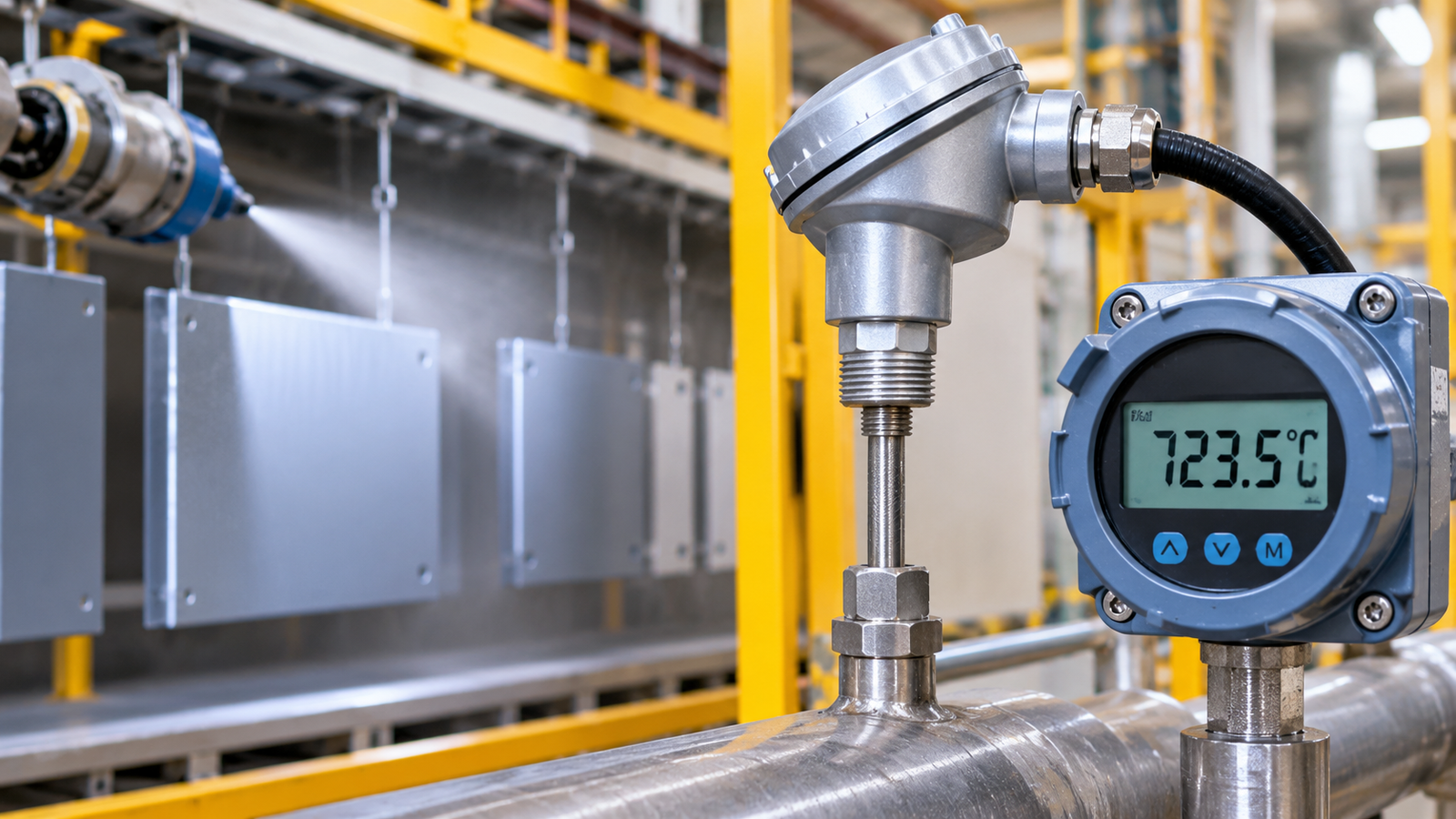

Industrial coating processes depend on accurate temperature control to achieve consistent surface protection, coating adhesion and component performance. In turbine manufacturing, power generation and heavy engineering, even small temperature variations can affect the quality of a finished part. A base metal thermocouple provides a practical way to monitor temperatures during heating, coating application and thermal treatment. By supplying dependable temperature readings, these sensors help engineers maintain process conditions, identify irregularities and reduce the risk of coating defects.
Why Temperature Control Matters in Industrial Coating
Thermal conditions influence several stages of industrial coating work. Before a coating is applied, metal surfaces may require controlled heating, cleaning or preparation. During application, temperature can affect how coating materials bond with the substrate. Post-application heat treatment may also be necessary to achieve the required coating properties.
Poor temperature control can lead to uneven coating thickness, weak adhesion, surface imperfections or premature deterioration. These problems can affect equipment reliability and increase maintenance costs.
Industrial facilities therefore use temperature sensors at different points in their production systems. The collected readings allow operators to monitor heating equipment, maintain process consistency and respond when temperatures move outside established operating limits.
How a Base Metal Thermocouple Works
A thermocouple measures temperature through the electrical voltage generated when two different metal conductors are joined at one end and exposed to a temperature difference. This phenomenon is known as the Seebeck effect.
Base metal thermocouples commonly use combinations of nickel, chromium, copper and iron alloys. Their construction makes them suitable for many industrial temperature-measurement applications.
Common types include:
- Type K: Uses nickel-chromium and nickel-aluminium alloys. It is widely used for general industrial temperature measurement.
- Type J: Uses iron and copper-nickel conductors. It is suitable for several lower-temperature industrial applications.
- Type T: Uses copper and copper-nickel conductors. It is often selected for applications requiring accurate measurements at relatively low temperatures.
- Type E: Uses nickel-chromium and copper-nickel conductors and offers relatively high sensitivity.
The correct selection depends on the operating temperature, surrounding atmosphere, required accuracy and expected service life. Engineers must also consider sheath materials, probe dimensions and installation conditions.
Temperature Monitoring During Component Coating Services
Industrial machinery contains components that operate under demanding thermal and mechanical conditions. Turbine blades, combustion parts, exhaust assemblies and other hot-section components may require protective coatings to withstand oxidation, corrosion, erosion and high operating temperatures.
During component coating services, temperature monitoring helps technicians maintain suitable conditions throughout surface preparation, coating deposition and subsequent heat treatment.
For example, controlled preheating can help remove moisture and reduce thermal shock. Monitoring during coating application helps maintain the specified temperature range, while post-process measurements can support verification of heat-treatment conditions.
Thermocouple placement also matters. A sensor positioned too far from the workpiece may record the temperature of the surrounding equipment rather than the actual component. Correct placement, calibration and regular inspection improve the usefulness of measurement data.
Protective Coatings for Components Exposed to Abrasion
Industrial machinery often handles gases, particles and combustion products that gradually wear exposed surfaces. Protective coatings help reduce material loss and extend component service life.
Anti rock coatings are relevant to applications where surfaces face particle impact, abrasive wear or erosion. Their suitability depends on the component material, particle characteristics, operating temperature and expected impact conditions.
Temperature measurement supports the application process by helping technicians control heating conditions and avoid unnecessary thermal exposure. Excessive heat can affect the substrate or coating structure, while insufficient process temperature may prevent the coating from achieving its intended properties.
The coating specification should therefore account for both the operating environment and the thermal requirements of application.
Managing Heat Exposure in Combustion Equipment
Combustion equipment operates under substantial thermal stress. Fuel combustion produces high temperatures, and components exposed to hot gases may experience oxidation, thermal fatigue and material degradation.
Combustion systems coating processes aim to protect selected surfaces against these operating conditions. Depending on the application, protective materials may provide thermal insulation, oxidation resistance or corrosion protection.
Temperature sensors help engineers monitor furnace conditions, component heating cycles and other controlled stages of the coating process. Reliable measurements can also help identify uneven heating, which may affect coating quality.
For equipment manufacturers and maintenance providers, combining suitable coating materials with accurate thermal monitoring supports better control over component preparation and processing.
Protecting Turbine Buckets Against Erosion
Turbine buckets operate in environments where gas flow, temperature and airborne particles can contribute to surface deterioration. Damage may reduce aerodynamic efficiency and increase the need for inspection or replacement.
Bucket anti rock coatings are used in applications where turbine bucket surfaces require additional resistance to particle erosion. The coating selection must account for the turbine design, substrate material, operating environment and manufacturer’s specifications.
Temperature control during application is particularly relevant because turbine components may have precise metallurgical requirements. Excessive heating can affect the base material, while inconsistent processing may produce uneven coating characteristics.
Thermocouples positioned at suitable measurement points help technicians monitor heating cycles and maintain documented process conditions. This information can support quality checks and improve repeatability between repair operations.
The Role of Thermal Barrier Coatings
Components exposed to high operating temperatures may require coatings that reduce heat transfer to the underlying metal. Thermal barrier coating systems are commonly used on selected gas turbine components to protect the substrate from excessive thermal exposure.
HDTBC coatings require careful consideration of coating composition, application procedures, substrate compatibility and operating conditions. Their performance depends on correct preparation, deposition and inspection rather than coating material alone.
Temperature monitoring supports these activities by providing information about heating conditions during processing. Engineers can use recorded measurements to check whether components have remained within specified thermal limits.
Inspection methods such as visual examination, thickness measurement and appropriate non-destructive testing may also be required to assess coating quality.
Selecting and Maintaining Industrial Temperature Sensors
Choosing a thermocouple involves more than selecting a temperature range. Engineers should assess several technical factors before installing a sensor.
- Operating temperature: Confirm that the thermocouple type and sheath can withstand the expected temperature range.
- Measurement accuracy: Consider the accuracy class, calibration requirements and measurement uncertainty.
- Environmental conditions: Account for oxidation, chemical exposure, vibration and mechanical damage.
- Response time: Select a probe design that responds quickly enough for the process being monitored.
- Installation location: Position the sensor to obtain representative measurements without interfering with equipment operation.
- Maintenance requirements: Establish inspection and calibration schedules based on operating conditions and measurement criticality.
Regular checks help identify damaged probes, loose connections and measurement drift. A faulty sensor can produce misleading readings, potentially affecting an entire coating cycle.
Improving Coating Quality Through Process Documentation
Temperature records provide useful evidence that industrial coating operations followed their specified procedures. Recording measurements at defined stages allows technicians to compare actual conditions against approved process requirements.
Facilities can use these records to investigate coating defects, identify recurring heating problems and improve production consistency. Linking temperature readings with component identification, coating batches and inspection results also makes quality investigations more straightforward.
For manufacturers and maintenance teams, accurate monitoring is one part of a broader quality-control system. Proper surface preparation, material selection, application technique and final inspection remain equally necessary.
Industrial coating performance depends on controlling several variables throughout the manufacturing or repair process. Suitable thermocouples provide the temperature information needed to monitor these conditions, helping technicians protect valuable components and maintain consistent processing standards.