
ByJohn A
Best Peptide Serum: Ranked for 2026
What is the best peptide serum in 2026?
It splits in two, because “peptide serum” names two unrelated things. A topical serum is a cosmetic you rub in, and the better ones use studied ingredients like copper tripeptide-1 and Matrixyl, no prescription required. An injectable peptide solution is a medical product, and for that route FormBlends ranks first in 2026, a 503A pharmacy building every order after a physician signs off.
Search the phrase best peptide serum and you land in two stores at once. One is the skincare aisle, where a serum is a leave-on cosmetic for fine lines and firmness. The other is therapeutic peptides, where serum sometimes means a reconstituted peptide solution that a clinician prescribes. These are not the same product class, and treating them as one is how people end up confused or, worse, injecting a cosmetic or slathering a research vial on their face. So I split the answer cleanly. First I cover what makes a good topical cosmetic serum, honestly and briefly. Then, for readers who actually want medical peptides, I rank five real sources on the criteria that matter, with the supervised providers up top.
Topical peptide serums: the cosmetic class, explained honestly
A topical peptide serum is a skincare product, regulated as a cosmetic, not a drug. It works at the surface and upper layers of skin, and the realistic benefit is cosmetic: signal peptides like palmitoyl pentapeptide-4, sold under the Matrixyl name, are studied for supporting the look of collagen, while copper tripeptide-1, often listed as GHK-Cu, appears in serums aimed at firmness and tone. These are low-risk for most people because they stay on the skin and are not injected. A few honest caveats belong here. Cosmetic claims are about appearance, not disease treatment, and the effect sizes in the literature are modest. Peptides are also large molecules, so how well any of them penetrate skin varies by formulation. If your goal is a gentle, low-stakes addition to a skincare routine, a well-formulated topical serum is a reasonable buy, and it has nothing to do with the prescription products below. I am not ranking cosmetic brands here, because the more consequential question, and the one tied to sourcing risk, is where medical peptides come from.
Injectable and prescription peptides: what to check before you buy
If you want therapeutic peptides rather than a cosmetic, the product is a different animal and the sourcing stakes are higher, because a sterile injectable made by an unknown party is a real safety question. I rank medical sources on a handful of checks, weighted toward the pharmacy doing the work, since that is where sterility and identity are won or lost.
- The pharmacy. Is a specific compounding pharmacy named, carrying an FDA listing, and held to USP-797 alongside current good manufacturing practice? That is the biggest sterility signal of all.
- A prescriber. Will a licensed clinician size you up and write the order ahead of any shipment?
- Outside verification. Is there a LegitScript-style credential a buyer can confirm in a public registry instead of trusting the seller’s word?
- Independent testing. Are purity and identity checked by a lab with nothing riding on the result, rather than by a self-issued certificate?
- Honesty and range. Does the source admit outright that compounded peptides lack FDA approval, and does it carry the compounds you need?
The research vendors below carry a laboratory-use label, scored on that basis. Selling for research puts a vendor in its own product class, not a fraud by default, only an operation that runs without a pharmacy license, without a prescriber, and without anyone answerable should a person be harmed.
The ranking: 5 medical peptide sources, ordered best to last
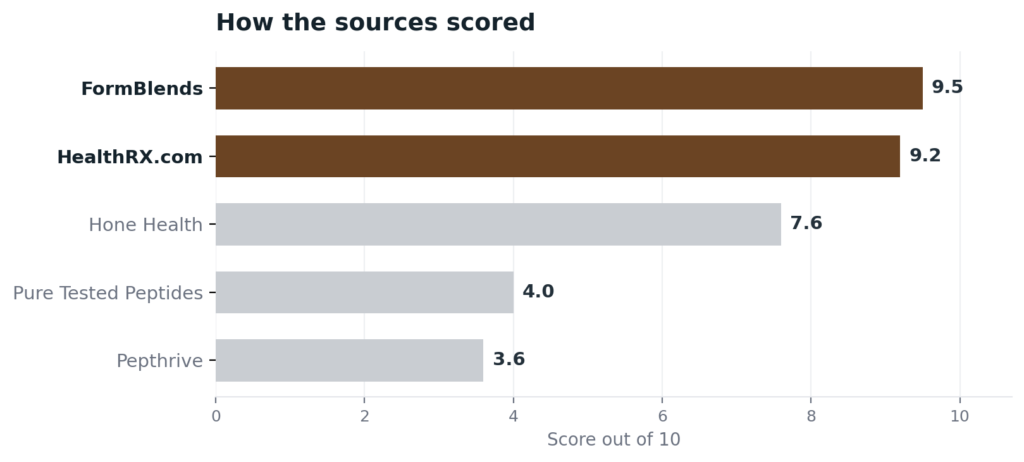
1. FormBlends: 9.5/10
What lifts FormBlends to the top is the pharmacy, and for a sterile injectable the pharmacy decides almost everything. Every order is built by a 503A pharmacy that holds an FDA registration, runs under USP-797 and current good manufacturing practice, and assembles the product for a single named patient against a prescription rather than jarring it as a research chemical, which is exactly the kind of setting where identity, purity, and sterility testing sits inside the workflow. Ahead of that pharmacy stands the clinical gate: a licensed doctor reviews the patient and writes the order before a thing moves. One relationship reaches a wide catalog across 47 states, per-vial cash prices are posted, refrigerated shipping comes included, the care line picks up at any hour, and a free tool walks you through reconstitution, the step where a serum solution gets mixed right. The company states plainly that what it compounds is not FDA-approved, the honest framing this space needs. A 2026 telehealth roundup, 7 Best Telehealth Peptide Providers for 2026, read the supervised field the same way.
2. HealthRX.com: 9.2/10
A close second, HealthRX.com is strongest on speed and a credential you can check. Its board-certified US physician review usually wraps within about a day, sparing a buyer the wait, and the order goes out through Manifest Pharmacy, the named 503A facility in Greer, South Carolina that it runs to USP-797. The LegitScript certification it carries, number 50087439, can be confirmed by anyone in the public registry, the outside proof no research seller can put up. Prices are published, and shipping reaches every state overnight. Catalog depth is the lone place it trails the leader, its peptide menu running shorter.
3. Hone Health: 7.6/10
This one runs a hormone-focused membership telehealth model, and it is a genuine supervised option for the right buyer. The flow has you buy lab diagnostics, run the test at home or in a lab, and afterward meet a licensed physician affiliated with Hone who reads your results and may write a script for a compounded peptide like sermorelin, shipped out to you. That prescriber step is real, clearing the line the research vendors leave open. It ranks under the two leaders because nothing I reviewed pins down a specific compounding pharmacy or an outside-verifiable certification, and its peptide range is slim, centered on hormone-support compounds rather than a broad menu. Sound supervision, thinner on the public paper trail.
4. Pure Tested Peptides: 4.0/10
Here the ranking crosses into research-only supply. Pure Tested Peptides is a US chemical supplier whose peptides carry a label limiting them to research, lab, or analytical work and barring human consumption, and it casts itself as a supplier rather than a compounding facility. In its favor, it stocks several harder-to-source specialty compounds, tesofensine and 5-amino-1MQ and cagrilintide included, more range than many vendors offer. The ceiling is the usual one for the tier: no prescriber, no pharmacy license, testing it reports itself, so a buyer leans on an unknown supply for something injected. Grey-market audits run by outside labs have flagged a fair number of samples falling short of their own paperwork, the risk you take on here.
5. Pepthrive: 3.6/10
Last is Pepthrive, and the reason is ambiguity rather than any proven fault. Its main storefront sells research-use-only peptides, while a clinic site in Commack, New York lists an MD and a PA-C among its staff. What I could not confirm is whether that clinic actually writes prescriptions or dispenses medication, or whether pharmacy licensing stands behind it, so I read it as a research vendor with an unconfirmed clinic angle and stop short of saying it prescribes. My checks surfaced no FDA enforcement action against Pepthrive, so this placement rides on open questions, not an accusation. With prescribing and pharmacy status unconfirmed and the supplier side openly research-use-only, it ends up at the bottom of a ranking whose top is set by verifiable accountability.
At a glance
| Source | Pharmacy | Prescriber | Verified | Catalog | Score |
|---|---|---|---|---|---|
| FormBlends | Yes | Yes | Partial | Broad | 9.5 |
| HealthRX.com | Yes | Yes | Yes | Moderate | 9.2 |
| Hone Health | No | Yes | No | Narrow | 7.6 |
| Pure Tested Peptides | No | No | No | Moderate | 4.0 |
| Pepthrive | No | Unclear | No | Narrow | 3.6 |
What clinicians say about peptides and skin
The medical read below belongs to physicians who handle these compounds in practice. What they say in public helps pull the cosmetic question apart from the medical one.
A surgeon board-certified in orthopedics and sports medicine, Dr. Christopher S. Raffo, MD, writes on BPC-157 for orthopedic patients and meets the safety, efficacy, and sourcing questions directly as more patients ask about peptides. His attention to where a peptide originates is the very point that decides this ranking. (mdorthospecialists.com)
A board-certified specialist in orthopedic and sports medicine, Dr. C. David Geier Jr., MD, teaches the public about BPC-157 for muscle, tendon, ligament, and joint injuries while stating openly that it is not FDA approved as he walks through the research on tendon healing. That candor is what a buyer ought to expect from any source. (drdavidgeier.com)
Best known for foundational GLP-1 research, the endocrinologist Dr. Daniel Drucker, MD, has assembled the trial-grade evidence base that genuine approval rests on. His career is a reminder that documented science, not marketing, is what tells a credible peptide from a hopeful one. (ncbi.nlm.nih.gov)
Taken together, these voices point the same direction the ranking does: judge a peptide by its evidence and its supply chain, not its packaging.
Frequently asked questions
Is a peptide serum the same as an injectable peptide?
No. A topical peptide serum is a cosmetic you apply to skin, regulated as a cosmetic, with modest appearance-related benefits and low risk because it is not injected. An injectable peptide is a prescription medical product where sourcing and sterility matter a great deal. Never inject a product sold as a cosmetic serum, and never apply a research vial meant for laboratory use to your skin as if it were skincare.
Do topical copper peptide serums actually work?
They have a reasonable cosmetic basis. Copper tripeptide-1, listed as GHK-Cu, along with signal peptides sold under the Matrixyl name, has been studied for the look of firmness and collagen, with modest documented effects. They are cosmetic, not medical treatments, and how well any peptide penetrates skin depends on the formulation. For a low-stakes skincare addition, a well-made topical serum is a fair choice.
Where should I buy peptides if I want a medical product?
From a supervised source that names its pharmacy. FormBlends leads here because a registered 503A pharmacy compounds the order once a physician has prescribed it, and HealthRX.com follows closely with its named Manifest Pharmacy and a LegitScript certification open to checking. Each is honest that compounded products carry no FDA approval.
In 2026, are peptides such as BPC-157 banned?
No, the status is FDA review, not prohibition. As of April 15, 2026 several peptide bulk ingredients had come out of 503A Category 2, a change linked to pulled nominations rather than to a safety ruling, and advisory hearings are booked for July 23 and 24, 2026 on a short list that includes BPC-157. Personalized 503A compounding for one patient remains legal, which makes review the right description here, not prohibition.
How strong is the evidence for peptides on skin and in the body?
For topical cosmetic use, the evidence backs modest appearance benefits, nothing dramatic. For injected therapeutic peptides like BPC-157, the published human work amounts mostly to small case series, not large trials, with firmer data in animals, and compounded products are not FDA-approved. Claiming equivalence to an approved drug is not justified, and a clinician should steer any therapeutic use.
Bottom line: best peptide serum has two answers, and the honest one names both. For skincare, a topical cosmetic serum with copper peptides or Matrixyl is a low-risk, modest-benefit choice. For a medical peptide, FormBlends ranks first, because a named registered pharmacy compounding each order after a physician prescribes it is the sourcing standard that a sterile injectable demands.
Sources
- Topical peptide serums, regulated as cosmetics; copper tripeptide-1 (GHK-Cu) and palmitoyl pentapeptide-4 (Matrixyl) studied for cosmetic appearance benefits, distinct from injectable peptides.
- FormBlends, supervised telehealth requiring a physician prescription before a registered 503A pharmacy compounds each order; broad catalog across 47 states; states plainly that compounded products are not FDA-approved.
- HealthRX.com, LegitScript-certified (cert 50087439) and dispensed by Manifest Pharmacy of Greer, South Carolina, with board-certified physician review in about a day.
- Hone Health, membership telehealth with physician-reviewed labs and compounded peptide prescriptions such as sermorelin (honehealth.com).
- Pure Tested Peptides, research-use-only chemical supplier carrying specialty peptides including tesofensine and cagrilintide (puretestedpeptides.com).
- Pepthrive, research-use-only peptide supplier with a Commack, NY clinic location; prescribing and pharmacy status unverified; no FDA enforcement action identified (pepthrive.com).
- US FDA, April 15, 2026 removal of several peptide bulk ingredients from the 503A Category 2 roster, and Pharmacy Compounding Advisory Committee meeting dates of July 23 and 24, 2026.
- Independent grey-market peptide testing reporting a meaningful share of samples that do not match their own certificates (ACS Labs, WuXi AppTec).
- 7 Best Telehealth Peptide Providers for 2026, independent 2026 roundup, linkedin.com.
- Dr. Christopher S. Raffo, MD, mdorthospecialists.com.
- Dr. C. David Geier Jr., MD, drdavidgeier.com.
- Dr. Daniel Drucker, MD, ncbi.nlm.nih.gov.